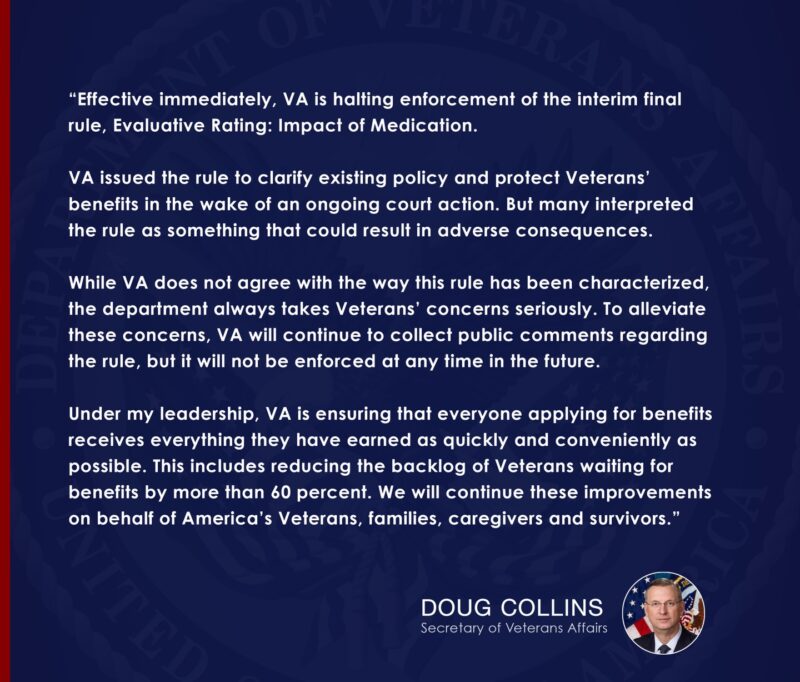
 The Department of Veterans Affairs has halted enforcement of a newly issued rule that would change how disability compensation is calculated, following widespread criticism from veterans and advocacy groups who warned the policy could reduce benefits.
The interim final rule, titled “Evaluative Rating: Impact of Medication,” amends 38 CFR § 4.10 within the VA Schedule for Rating Disabilities (VASRD). It was published in the Federal Register and took effect February 17, 2026. Public comments are being accepted through April 20, 2026, under RIN 2900-AS49 at Regulations.gov.
The amendment clarifies the VA’s longstanding interpretation of § 4.10, stating that disability evaluations must reflect the actual level of functional impairment a veteran experiences under ordinary conditions of daily life — including the effects of medication or treatment.
Under the rule, medical examiners are instructed not to estimate or discount improvements caused by medication. If medication lowers the level of disability, the rating must be based on that lowered level.
“To ensure that disability evaluations are based on the actual level of functional impairment under the ordinary conditions of daily life, the medical examiner will not estimate or discount improvements to the disability due to the effects of medication or treatment,” the rule states. “If medication or treatment lowers the level of disability, the rating will be based on that lowered disability level.”
In practical terms, a veteran with a service-connected knee injury who functions better while taking prescribed medication could receive a lower disability rating than if the condition were evaluated without considering the medication’s effects.
VA officials said the rule was necessary to correct what they describe as judicial misinterpretations of disability regulations, particularly a 2025 decision by the U.S. Court of Appeals for Veterans Claims in Ingram v. Collins. That ruling required the VA, when evaluating certain musculoskeletal conditions, to disregard the “ameliorative effects” of medication and instead estimate the severity of a disability as if it were untreated.
The VA argues that such an approach forces examiners and adjudicators to engage in speculation about what a veteran’s symptoms might be without medication — a process the department says contradicts longstanding regulatory principles.
Federal law directs that disability ratings reflect the “average impairments of earning capacity” resulting from service-connected injuries. VA regulations in 38 CFR Part 4 emphasize that ratings must be based on accurate medical examinations describing how a disability affects ordinary activity and employment. The U.S. Court of Appeals for the Federal Circuit has previously stated that the rating system is designed to compensate for the actual level of earning impairment experienced by a veteran.
In its notice, the VA warned that applying Ingram broadly could affect more than 500 diagnostic codes and require re-adjudication of over 350,000 pending claims. Officials said compliance would generate significant administrative costs, burden examiners, delay benefits decisions, and increase compensation expenditures for disability levels “that veterans are not actually experiencing.”
The department issued the rule as an interim final regulation without prior notice and comment, citing “good cause” under the Administrative Procedure Act. Officials said immediate implementation was necessary to prevent systemic disruption in the disability claims process. The Office of Information and Regulatory Affairs classified the action as a major rule under the Congressional Review Act, with an expected economic impact exceeding $100 million annually.
VA Press Secretary Peter Kasperowicz previously stated that the action would not affect any veteran’s current disability rating.
“This action will have no impact on any veteran’s current disability rating,” Kasperowicz said.
Despite that assurance, veterans and advocacy groups quickly criticized the rule, arguing that tying disability ratings to how well someone functions while medicated could lower ratings and reduce compensation for many former service members.
“This is an erosion of benefits,” said Jason Cameron, a Marine Corps veteran and retired veterans benefits service officer from Monterey County, California.
The Veterans VA Benefits and Claims Assistance group, which has more than 68,000 members on Facebook, warned that ratings would now be based “on how you’re doing on your present medication, not how bad your condition is without it.”
The VA distributes more than $150 billion annually in disability compensation. While the department maintains the rule reinforces longstanding policy and protects the integrity of the disability rating system, backlash from veterans across the country prompted officials to pause enforcement while reviewing concerns raised during the public comment period.