
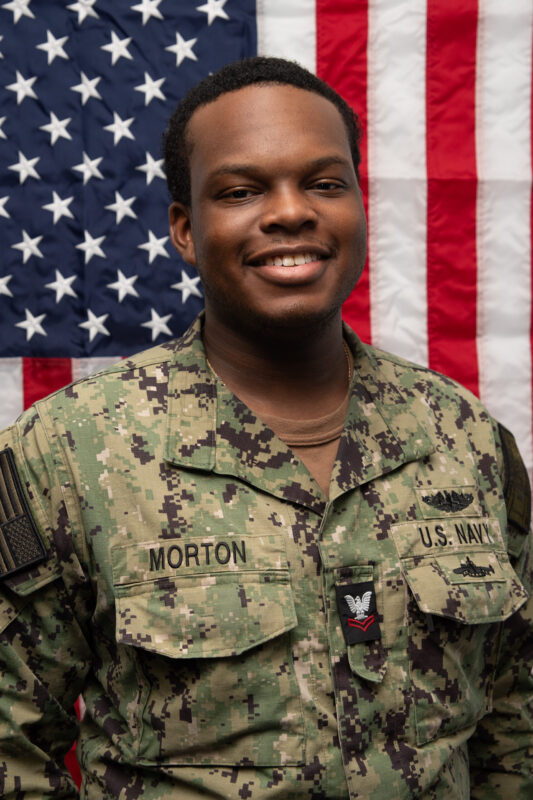
Justin Morton
By Mass Communication Specialist 1st Class Mitch Meppelink, Navy Office of Community Outreach – KINGS BAY, GA. – Petty Officer 2nd Class Justin Morton, a native of Upper Marlboro, Maryland, serves the U.S. Navy assigned to USS Tennessee, homeported at Naval Submarine Base Kings Bay. As a submariner, Morton is part of a small percentage of Navy personnel continuing a 125-year tradition of service under the sea to help ensure Americans’ safety.
Morton graduated from Bishop McNamara High School in 2018.
The skills and values needed to succeed in the Navy are similar to those found in Upper Marlboro.
“I learned growing up that being social and talking with people goes a long way,” Morton said. “If I don’t know how to do something, I can reach out to people who have done it or experienced it, and they can teach me because trying to do it on my own won’t get me very far.”
Morton joined the Navy three years ago. Today, Morton serves as an electrician’s mate.
“I joined the Navy to make myself marketable,” Morton said. “I also wanted to set myself up for the future. After watching both my mom and dad serve in the Air Force, I knew the benefits of the military and the importance of following that tradition as well.”
Naval Submarine Base Kings Bay is the homeport of East Coast ballistic-missile and guided-missile submarines. These submarines are capable of conducting operations in the Atlantic, Arctic, Eastern Pacific, and Indian Oceans and the Mediterranean Sea. It is also the only Navy base with the capability to support the Trident II missile, the most sophisticated nuclear missile designed to be launched from a submarine.
Known as America’s “Apex Predators!,” the Navy’s submarine force operates a large fleet of technologically advanced vessels. These submarines are capable of conducting rapid defensive and offensive operations around the world, in furtherance of U.S. national security.
There are three basic types of submarines: fast-attack submarines (SSN), ballistic-missile submarines (SSBN) and guided-missile submarines (SSGN).
Fast-attack submarines are designed to hunt down and destroy enemy submarines and surface ships; strike targets ashore with cruise missiles; carry and deliver Navy SEALs; conduct intelligence, surveillance, and reconnaissance missions; and engage in mine warfare. The Virginia-class SSN is the most advanced submarine in the world today. It combines stealth and payload capability to meet Combatant Commanders’ demands in this era of strategic competition.
The Navy’s ballistic-missile submarines, often referred to as “boomers,” serve as a strategic deterrent by providing an undetectable platform for submarine-launched ballistic missiles. SSBNs are designed specifically for stealth, extended patrols and the precise delivery of missiles. The Columbia-class SSBN will be the largest, most capable and most advanced submarine produced by the U.S. – replacing the current Ohio-class ballistic-missile submarines to ensure continuous sea-based strategic deterrence into the 2080s.
Guided-missile submarines provide the Navy with unprecedented strike and special operation mission capabilities from a stealthy, clandestine platform. Each SSGN is capable of carrying 154 Tomahawk cruise missiles, plus a complement of heavyweight torpedoes to be fired through four torpedo tubes.
Strategic deterrence is the nation’s ultimate insurance program, according to Navy officials. As a member of the submarine force, Morton serves aboard a platform capable of bringing the fight to enemies in defense of America and its allies.
The U.S. Navy is celebrating its 250th birthday this year.
According to Navy officials, “America is a maritime nation and for 250 years, America’s Warfighting Navy has sailed the globe in defense of freedom.”
With 90% of global commerce traveling by sea and access to the internet relying on the security of undersea fiber optic cables, Navy officials continue to emphasize that the prosperity of the United States is directly linked to recruiting and retaining talented people from across the rich fabric of America.
Morton has many opportunities to achieve accomplishments during military service.
“My proudest accomplishment is completing the nuclear pipeline,” Morton said. “It was two years of countless tests and endless hours of studying. Everything about it was a lot, and being able to experience and complete that is a great accomplishment.”
Morton serves a Navy that operates far forward, around the world and around the clock, promoting the nation’s prosperity and security.
“To me, serving means trust,” Morton said. “Regardless of anyone’s background, when the going gets rough, the person next to me has my back, and I have theirs.”
Morton is grateful to others for helping make a Navy career possible.
“I want to thank my family,” Morton added. “My family has supported me throughout my entire journey.”