UPDATE 10/7/2025: Since updating this article on September 30th, 2025, St. Mary’s County is receiving many sighting reports of the Spotted Lanternfly, especially in Northern parts of the county near Mechanicsville, Chaptico, and Seventh District.
The photo below was posted by the Goldpetal Farms Maryland in Chaptico, St. Mary’s County, MD on October 7th, 2025.
Residents should report sightings to the Maryland Department of Agriculture, remove and dispose of any eggs they find, and treat infestation with recommended insecticides or by using trap trees, as they are a permanent pest.
A picture is required when submitting a report. Submitting a report does not trigger a response from our team and is not considered a request for more information. If you have any questions or concerns, please email us at [email protected]. (We are taking reports from every county in Maryland.)
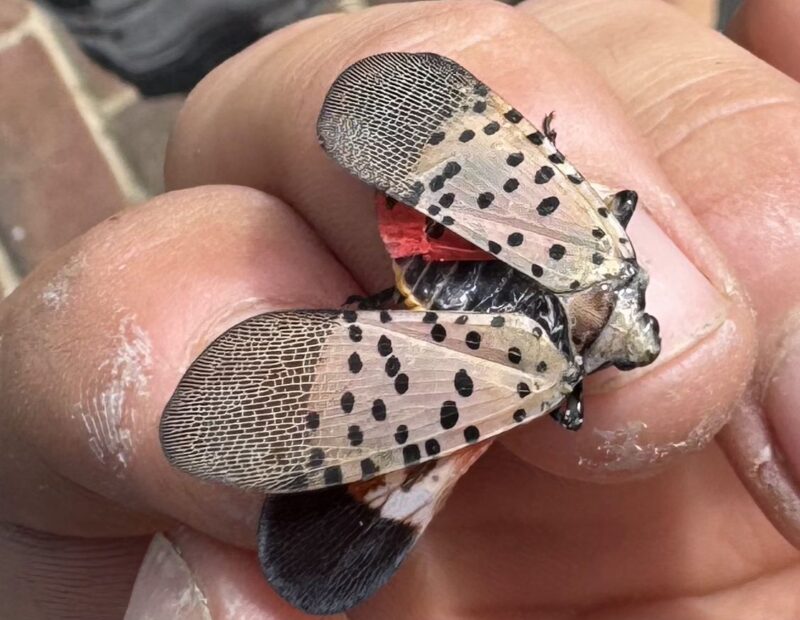
Photo by Goldpetal Farms in Chaptico, St. Mary’s County, MD on October 7th, 2025.
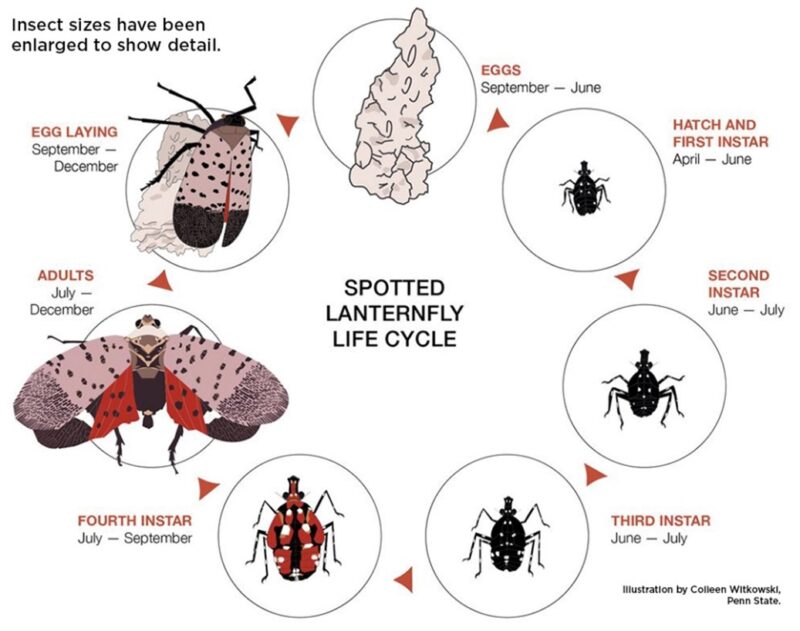
The Spotted lanternfly (Lycorma delicatula) is an invasive insect (planthopper) native to eastern Asia. It was first detected in the United States in 2014 in Berks County, Pennsylvania.
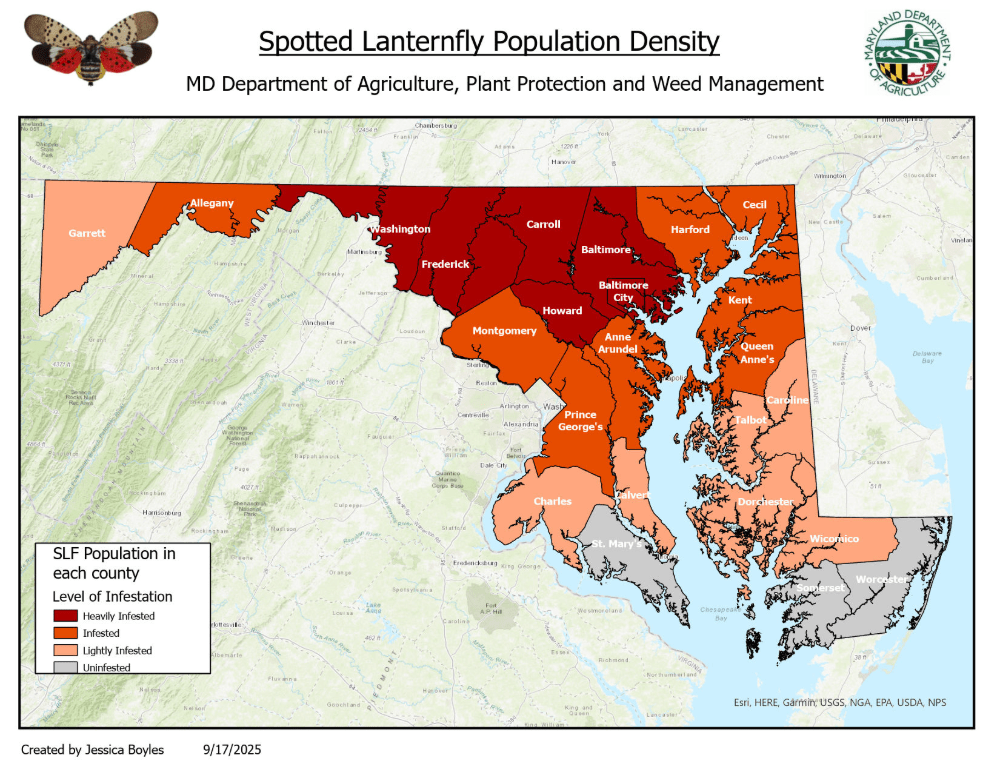
In Maryland, it was first found in Cecil County in October 2018. With a quarantine order being placed in 2019 which included Cecil and Harford counties, which have established spotted lanternfly populations.
In early 2022 and 2023, the quarantine zone was expanded to additional jurisdictions based on the confirmed existence of known spotted lanternfly populations in these areas. Allegany, Anne Arundel, Baltimore, Calvert, Caroline, Carroll, Cecil, Frederick, Harford, Howard, Kent, Montgomery, Prince George’s, Queen Anne’s, Talbot, Washington and Wicomico, as well as Baltimore City.
-
This pest does not bite or sting. Spotted lanternfly has piercing-sucking mouthparts and feeds on plant sap from a wide range of plants including grapes, hops, apples, stone fruits, maples, walnuts, and other plant species. Its feeding has not killed plants (except for grapes). It is primarily a threat to Maryland’s agricultural crops.
-
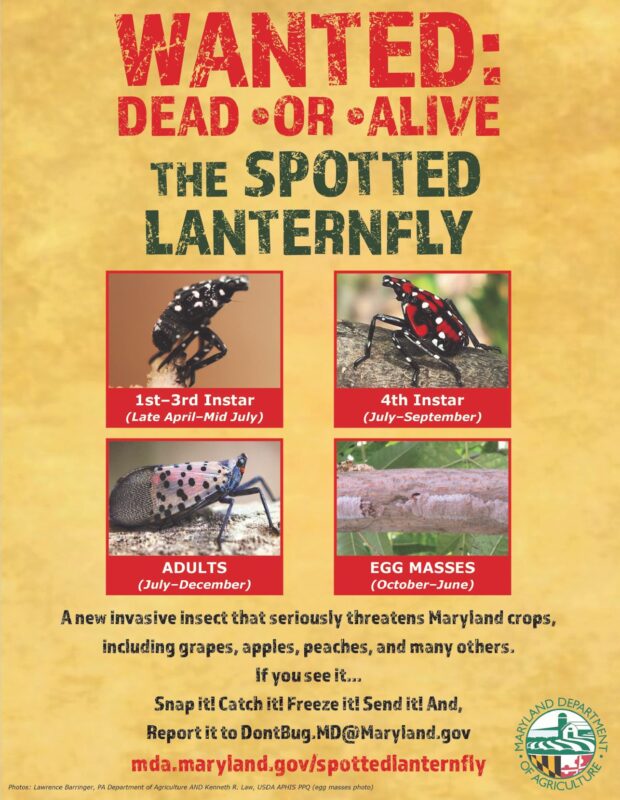
All Maryland residents, from any county, are urged to report sightings of Spotted Lanternfly to the Maryland Department of Agriculture (MDA). This data is important for tracking phenology and population levels. Submit your reports through this online form. Questions or concerns about this pest also can be submitted to UMD Ask Extension, by email to [email protected], or call (410) 841-5920. Control information can be found at the bottom of this page.
A primary host plant for the spotted lanternfly is tree-of-heaven (Ailanthus altissima), an invasive weedy tree that grows in disturbed areas on field edges and roadsides. Early research suggests that spotted lanternfly may prefer to feed and reproduce on tree-of-heaven, but research has shown it also can complete its life cycle on a wide range of other plant species. Refer to our information about tree-of-heaven and how to remove it.
How does Spotted Lanternfly affect Maryland?
Spotted lanternfly pose a risk to local Maryland vineyards, can impact our local ecosystem, and are a nuisance to Maryland citizens.
Spotted lanternfly do not feed on flowers, leaves or fruit. Instead, they eat phloem or sap from the trunks and stems of their host plants. They are also non-toxic if ingested by pets. Spotted lanternfly will not bite or sting you. They pose no danger to you or your pets.
Spotted lanternfly feeding is a significant stressor. Though we have not seen plant death due to spotted lanternfly alone. It has been shown to stunt growth, reduce crop yields and cause localized damage.
Spraying pesticides, including home remedies, can do more harm than good when it comes to spotted lanternfly in residential greenspaces. Any chemicals can potentially harm pollinators and beneficial insects.
One of the best way to remove these invasive insects, is to identify and remove tree-of-haven host plants. Due to the insects natural un-appetizing tastes and their diet of his plant, birds tend to avoid them due to this.
Cultural control
- Remove one of spotted lanternfly’s primary host plants, tree-of-heaven (Ailanthus altissima), from your property. Tree-of-heaven looks very similar to native sumac and black walnut, so correct identification of the plant is important. Watch this short video on tree-of-heaven and native look-alikes. Contact us if you need help with plant identification or information about control methods.
- Place exclusive netting with fine mesh over vulnerable plants like grape vines, tightly securing the sides and bottom of the netting. Spotted lanternfly may feed on any plant stems in direct contact with the netting. It is important to note netting could increase disease pressure under certain environmental conditions.
Mechanical Control:
This is our recommend method for spotted lanternfly management. These methods are the least environmentally impactful. They are also easily accessible to every Maryland citizen.
- Flyswatters and nets are easy ways to catch and kill spotted lanternfly.
- Hand vacuums or shop vacuums can remove spotted lanternfly from vegetation and structures around your property. Spotted lanternfly caught can simply be thrown away.
- Circle traps are a great way to passively trap spotted lanternfly. They do not require a lure or any chemicals. Spotted lanternfly are poor flyers and climb up trees to feed on stems and jump to glide to their next location. The circle trap cut off access to the tops of trees and funnels them into a plastic bag. This bag can be replaced and the old one thrown away. We do not recommend sticky tape or glue traps, as they have a high rate of by-catch, Often leading to beneficial insects, small mammals, reptiles and even birds getting caught. You can purchase pre-built traps online. Or you can follow a tutorial here to build one yourself. It is important to remember that the mesh must wrap around the entire tree. If not spotted lanternfly can by-pass the trap. It can be necessary to use two traps to fully cover a tree.
- Removal of egg masses in the winter is also effective. Every egg mass you remove is 30 – 50 less spotted lanternfly that will hatch in the spring.
*Maryland Department of Natural Resources and University of Maryland Extension information.