
 Legislation strongly supported and championed by St. Mary’s County State’s Attorney Jaymi Sterling, House Bill 674 / Senate Bill 394, Criminal Law – Concealment of Death and Disturbing and Dismembering Human Remains, is enacted into law today, October 1st, 2025.
This new statute is a criminal felony punishable by up to five years in prison for concealing a death or disturbing and dismembering human remains and is a significant victory for public safety and families seeking justice and closure.
In her first term as State’s Attorney, Sterling and her team were presented with multiple homicide cases involving the dismemberment of human remains and the concealment of death. “I was shocked to learn that the only applicable law for this egregious offense was a one-year misdemeanor. What was more worrisome is that this law was codified as a misdemeanor rather than as a felony criminal violation,” said Sterling. “The utility of a one-year misdemeanor is essentially meaningless, as locating and identifying a victim at this stage is susceptible to statute of limitation challenges.”
What started as a troubling concern quickly fueled Sterling into action. She worked closely with Senator Jack Bailey and Delegate Aaron Kaufman and garnered strong support in both Houses of the General Assembly.
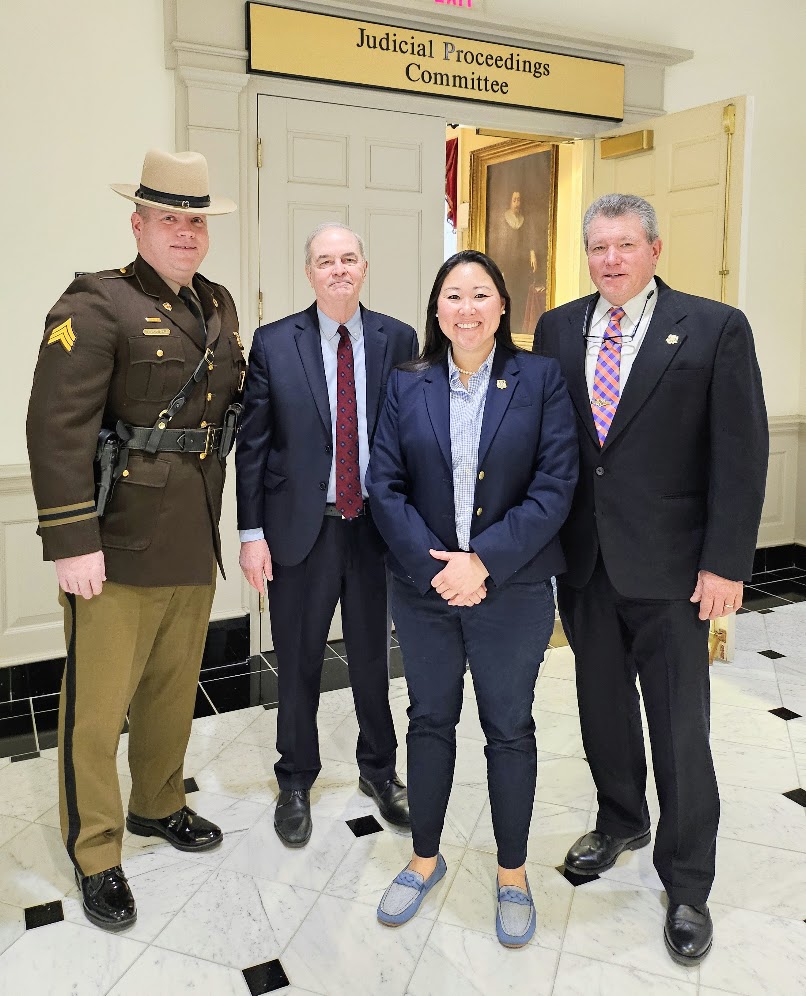
Sterling and her fellow elected State’s Attorneys united to testify before the Maryland Senate Judicial Proceedings Committee and the House Judiciary Committee. The legislation was marshaled across the finish line impressively in its first year of introduction. “I am grateful to the Maryland General Assembly for recognizing the urgency and necessity of this law,” said Sterling. “It ensures that individuals who attempt to hide the truth of a death through acts of dismemberment or concealment are held accountable. This is about dignity for victims and justice for their loved ones.”
Sterling’s original proposal included a felony classification punishable by ten years in prison. After debate in the Maryland General Assembly, lawmakers agreed to pass the legislation as a felony, but they reduced the maximum allowable punishment from ten to five years in prison.
This law fills a gap in Maryland legislation and represents a meaningful step forward in providing law enforcement officers and prosecutors with the ability to combat these elevated criminal acts.