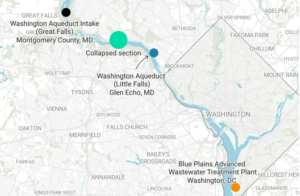
This map shows the location of a collapsed pipe that began sending raw sewage into the Potomac River on Jan. 19, 2026. (Courtesy of DC Water)
Congressman Steny H. Hoyer (MD-05), U.S. Senator Chris Van Hollen (D-MD), and 9 additional members of Congress who represent Maryland and Virginia wrote to DC Water CEO and General Manager David Gadis, expressing serious concern over the public health and environmental impacts of the disastrous sewage spill into the Potomac River following the collapse of a major sewer line last month – and called for the utility to take a series of actions and increase public transparency as the response and recovery efforts continue.
Joining Congressman Hoyer and Senator Van Hollen on this letter are Senator Angela Alsobrooks (D-MD) and U.S. Representatives Jamie Raskin (MD-08), Sarah Elfreth (MD-03), April McClain Delaney (MD-06), Johnny Olszewski (MD-02), Suhas Subramanyam (VA-10), Eugene Vindman (VA-07), and James Walkinshaw (VA-11).
“We write to express our serious concern around the collapse of the Potomac Interceptor sanitary sewer line that was discovered on January 19 along Clara Barton Parkway and the Chesapeake and Ohio (C&O) Canal National Historical Park in Montgomery County, Maryland. The failure of this 72-inch diameter pipe, which conveys approximately 60 million gallons of wastewater per day from communities in Maryland and Virginia to the Blue Plains Advanced Wastewater Treatment Plant in Washington, D.C., resulted in a massive discharge of raw, untreated sewage into the Potomac River,” the lawmakers began.
“This is one of the largest sewage spills in our country’s history, and its consequences for public health, the environment, and our communities demand a comprehensive and sustained response as well as clear communication with the public.”
They thanked DC water employees and contractors for braving difficult conditions to conduct critical containment and repair work, but also underscored the ongoing risks to the public and the environment in the wake of this disaster, writing, “while we appreciate the ongoing emergency response, we remain deeply concerned about the near-term public health and environmental impacts of this spill. Independent testing conducted by University of Maryland researchers and the Potomac Riverkeeper Network, as well as DC Water’s own testing, have revealed alarming contamination levels in the river, and the full scope of the environmental damage is still not fully understood.”
The lawmakers went on to urge DC Water to commit to the following actions as the repair and recovery work continues:
- Frequent and transparent public communication;
- Develop a comprehensive environmental impact assessment and remediation plan;
- Regular public briefings with opportunities for direct community engagement with DC Water;
- Continued water quality monitoring through spring and summer; and
- Ongoing communication with the regional Congressional delegation.
“We are closely monitoring this situation and stand ready to assist in any way we can. Our offices will continue to relay the concerns of our constituents to DC Water and work with all relevant stakeholders to ensure a full and effective response to this crisis. Thank you for your consideration and we look forward to your response,” the lawmakers concluded.
Text of the letter can be viewed here and below.
Dear Mr. Gadis: We write to express our serious concern around the collapse of the Potomac Interceptor sanitary sewer line that was discovered on January 19 along Clara Barton Parkway and the Chesapeake and Ohio (C&O) Canal National Historical Park in Montgomery County, Maryland. The failure of this 72-inch diameter pipe, which conveys approximately 60 million gallons of wastewater per day from communities in Maryland and Virginia to the Blue Plains Advanced Wastewater Treatment Plant in Washington, D.C., resulted in a massive discharge of raw, untreated sewage into the Potomac River.
Before DC Water was able to activate a bypass system on January 24, an estimated 40 million gallons of wastewater per day overflowed from the collapse site, with approximately 243 million gallons of untreated sewage reaching the river in total according to DC Water’s estimates.
The Potomac River is a vital natural resource that provides drinking water to five million people, supports a rich and diverse ecosystem, and serves as a source of recreation, livelihood, and pride for communities across our region. This is one of the largest sewage spills in our country’s history, and its consequences for public health, the environment, and our communities demand a comprehensive and sustained response as well as clear communication with the public.
We want to first acknowledge and thank the DC Water employees and contractors who have been working around the clock in extremely challenging winter conditions to contain the spill, install and maintain bypass pumping systems, and begin the complex work of cleaning and repairing the damaged pipe. The dedication of these workers, who have persevered through freezing temperatures and heavy snow, reflects the highest standards of public service and deserves our recognition and gratitude.
While we appreciate the ongoing emergency response, we remain deeply concerned about the near-term public health and environmental impacts of this spill. Independent testing conducted by University of Maryland researchers and the Potomac Riverkeeper Network, as well as DC Water’s own testing, have revealed alarming contamination levels in the river, and the full scope of the environmental damage is still not fully understood.
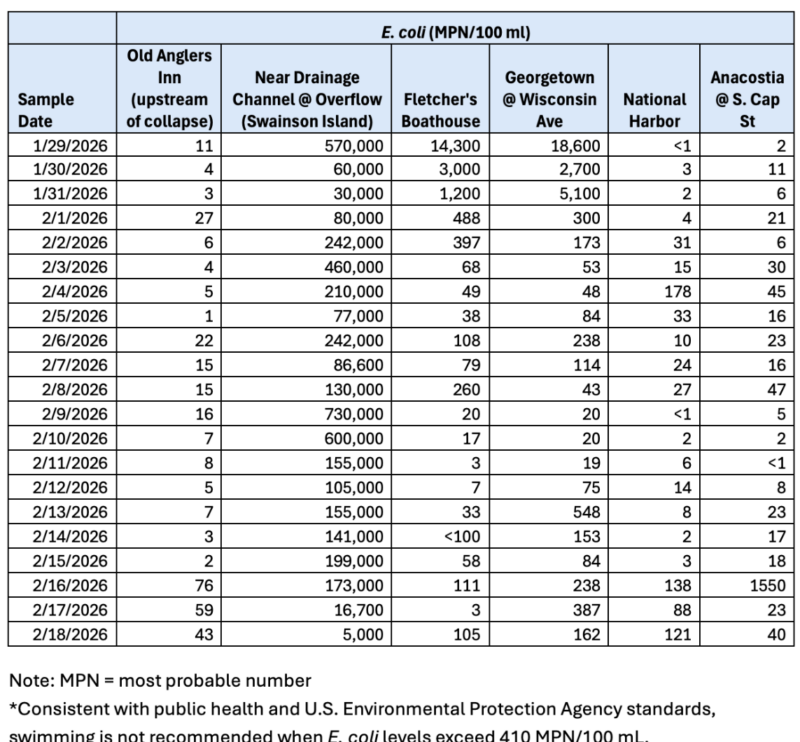
Water samples collected at the spill site have shown E. coli bacteria concentrations more than 10,000 times above Environmental Protection Agency (EPA) recreational water quality standards, and elevated contamination levels above EPA standards have been detected at downstream locations as well. University of Maryland’s testing also detected S. aureus, the bacteria responsible for staph infections, at one-third of sampling sites. And MRSA, a highly dangerous antibiotic-resistant strain of S. aureus, was detected at the sewage overflow site. As of February 16, E. coli levels near the Lock 10 drainage channel remained severely elevated, and DC Water has acknowledged a significant reporting error in which actual E. coli concentrations on February 6 at this location were approximately 100 times higher than initially disclosed.
We are also concerned about the potential ecological impacts of this spill on fish, wildlife, and their habitats. The Potomac Gorge, the section of the river where this spill occurred, is one of the most significant biodiversity hotspots on the East Coast and home to over 1,500 species, including nearly 200 that are listed as rare, threatened, or endangered. The introduction of hundreds of millions of gallons of raw sewage into this ecosystem risks cascading harm to fish populations, aquatic invertebrates, and the wildlife that depend on them. There have already been credible reports of fish kills downstream of the spill and the Maryland Department of the Environment took the precautionary step of closing shellfish harvesting areas along part of the lower Potomac River, demonstrating that a full accounting of these impacts is essential.
Furthermore, recent cold weather conditions are compounding these risks. Cold water temperatures near the spill site will slow bacterial die-off and allow harmful pathogens to survive longer and travel farther downstream. Additionally, ice cover on portions of the river reflects sunlight that would otherwise help sterilize the water, and the river’s current drought conditions have reduced the natural dilution of contaminants. There is also significant concern that frozen sewage in the water column and along shorelines may trigger delayed contamination events and additional harm to the river and public health when temperatures rise.
Given the severity and ongoing impacts of this incident, we request that DC Water commit to the following actions:
- Frequent and Transparent Public Communication: We ask that DC Water continue to provide frequent, accurate, and transparent updates to the public regarding the status of repair work at the collapse site, bacteria levels in the river associated with the sewer line collapse and the corresponding public health risks, and any other developments related to this incident. The recent discovery of a significant rock blockage in the sewer line that will add four to six weeks to the timeline for repairs and overflows that continue to occur at the break site demonstrate the importance of these updates. It is imperative that the information DC Water provides to the public be rigorously verified, clearly communicated, and transmitted in a timely fashion.
- Comprehensive Environmental Impact Assessment and Remediation Plan: We ask that DC Water partner closely with federal, state, and local officials, as well as environmental organizations and research institutions working on the ground, to develop and publicly release a thorough assessment of the spill’s environmental impacts alongside a comprehensive timeline for environmental remediation at all impacted sites. This rigorous study and plan should include:
- An assessment of the spill’s impact on fish, wildlife, and the ecologically sensitive habitats within and near the Potomac River.
- An assessment of any impact on the C&O Canal National Historical Park, a treasured site for recreation which is currently serving as the temporary bypass venue for diverted sewage and may have sustained environmental harm as a result.
- An assessment of potential downstream impacts to water quality in the Chesapeake Bay, given that the Potomac River is one of the Bay’s largest tributaries and that contamination has already been detected miles downstream of the spill site.
- A clear and detailed plan for the environmental remediation needed to address the ecological damage caused by this spill, including timelines, responsible parties, and coordination with relevant regulatory agencies.
- Public Briefings: We ask that DC Water hold regular public briefings on the incident and its ongoing impacts to inform members of the local community and provide them with opportunities to ask questions and share their concerns directly with DC Water leadership. The residents, businesses, and recreational users who depend on the Potomac River and the C&O Canal deserve direct forums to engage with DC Water on the response, the remediation plan, and what steps are being taken to prevent a disaster of this magnitude from occurring again. We appreciate that you are working toward providing opportunities for the community to directly engage with DC Water, as you stated in your recent Open Letter, and that you are planning an in-person community meeting with regional leaders and public health agencies for the week of February 23.
- Continued Water Quality Monitoring Through Spring and Summer: We ask that DC Water commit to sustained water quality monitoring well into the spring and summer months to ensure that bacteria levels return to safe standards before the recreational season and to detect any delayed contamination from frozen sewage and sediment-trapped pollutants. Testing results should continue to be released to the public on a regular basis.
- Ongoing Communication with the Congressional Delegation: We ask that DC Water continue to keep Members of Congress representing the District of Columbia, Maryland, and Virginia closely informed as repair work progresses and as you pursue the necessary infrastructure upgrades and environmental remediation. We are prepared to support efforts to secure the federal resources and technical assistance needed to address both this incident and the broader challenge of aging wastewater infrastructure in our region.
We are closely monitoring this situation and stand ready to assist in any way we can. Our offices will continue to relay the concerns of our constituents to DC Water and work with all relevant stakeholders to ensure a full and effective response to this crisis. Thank you for your consideration and we look forward to your response.
2/20/2026 Most recent update from DC Water – DC Water has successfully reached the damaged section of the Potomac Interceptor, marking a critical step in the ongoing damage assessment and repair efforts. Crews today are manually digging out the affected area, carefully removing sludge, soil, and debris from the collapsed pipe. The work is slow and painstaking, as large boulders and rocks complicate the excavation process. Crews are using both manual labor and an excavator to clear obstructions, working carefully not to cause any additional damage.
A section of the sewer line collapsed on January 19, along Clara Barton Parkway and the I-495 interchange in Montgomery County, MD and the C & O Canal National Historical Park. An estimated 243.5 million gallons of wastewater has overflowed, most of that in the initial week and no overflows entering the river have occurred in the past 11 days.
Water Quality Sampling Results:
DC Water is performing daily water quality sampling. It’s important to note that historically the E. coli levels in the Potomac and Anacostia rivers vary widely from day to day. Fluctuations in water quality are influenced by factors such as weather events, river flow, runoff, pollutants, and other sources discharging into waterways; and measurements taken much further downstream cannot be attributed solely to this incident.
For the Potomac River, historical water quality data shows E. coli levels may vary from a range as low as 10 MPN/100mL to as much as 5,000 MPN/100mL on a given day.
A more detailed explanation is posted on the District Department of Energy and Environment (DOEE) website at https://doee.dc.gov/release/potomac-interceptor-update-and-faqs.