
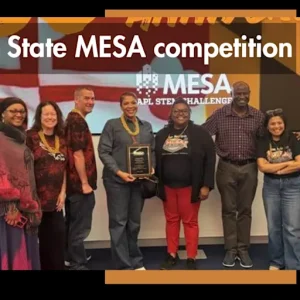
 Four Charles County Public Schools (CCPS) teams placed at the state MESA Day competition last month at the Johns Hopkins Applied Physics Laboratory. The Mathematics, Engineering and Science Achievement (MESA) competition challenges students in elementary through high school to use ingenuity and creativity to tackle specific science, technology, engineering and mathematics (STEM) challenges.
Teams from William A. Diggs and Dr. Samuel A. Mudd elementary schools placed first in their categories with a team from La Plata High School placing third.
Alongside the competition, Simone Young, CCPS coordinator of STEM education, was honored with the inaugural Trailblazer in STEM Award.
Team players
A team from Diggs took first place in the Community Clean Up Challenge. Team members include Micah Enchill, Bryce Muschette, Bryce Thompson and Bryson Wooster. The coaches are kindergarten teacher Traci Davis and science teacher Michael Johnson. The Community Clean Up Challenge calls for students to design an environmental superhero known as the Super Clean Machine. The machine must be automated and generate its power from the sun, wind or water.
The Wearable Technology Challenge team from Dr. Mudd placed first at the competition. The team is made up of Joshua Ferguson, Noel McPherson, Amanda Sanchez and Elizabeth Rodriguez Zelaya. Fourth-grade teacher Brandy Alexander and Maribel Reyes, the school’s technology facilitator, are the team coaches. The Wearable Technology Challenge this year prompted teams to design and build a device an athlete can wear to prevent heat exhaustion.
Students from Diggs received first place for the Storybook Theme Park Ride Challenge. Members include John Aaron Bassig, Alianna Grace Moten, Aamir Logan and Danny McFadden Jr. Davis and Johnson coach the team. The challenge asks teams to design and make a functional model of a theme park ride based on a storybook of the team’s choosing.
La Plata’s National Engineering Design Competition (NEDC) team of Paul Blachek, Pranesh George, Elijah Merkle and Marcellus White took third place. The team is coached by science teachers Rachel Clark and Marisa Capalbo. The NEDC challenged teams to identify an issue dealing with inequity, engineer and present a solution after developing a prototype. The design must stay on the theme of Designing for Equity Locally to Affect Sustainability Globally.
Trailblazer in STEM
Young began her career in education as a science teacher with Prince George’s County Public Schools. She taught middle school science and high school biology with some college-level genetics and information technology courses thrown in over the years.
She came to CCPS in 2011 as an instructional resource teacher at North Point High School where she took the opportunity to work closely with career and technical education (CTE) instructors. After a couple of years, Young became the coordinator for STEM education with CCPS where she has led efforts to expand access to STEM and computer science instruction.
“STEM education is about so much more than just teaching content. It’s about helping students build the skills and confidence they need to navigate an ever-changing world,” Young said. “When students engage in competitive STEM, they’re not just solving problems—they’re learning how to collaborate, think critically and stay resilient.”
A concept Young often champions is “failing forward.”
“We want students to understand that failure isn’t something to avoid — it’s actually part of the process,” she said. “It’s how you refine your ideas and ultimately get to better solutions. That mindset is so important, not just in STEM, but in life.”