
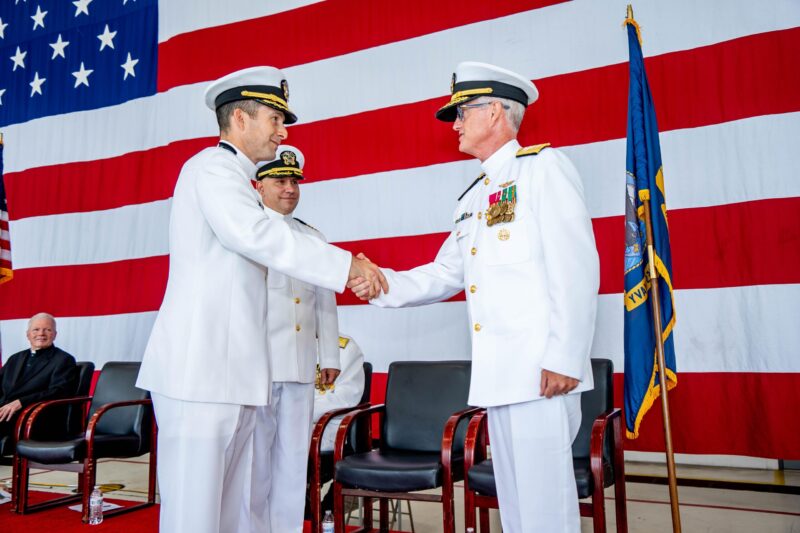
Program Executive Officer for Unmanned Aviation and Strike Weapons Rear Adm. Stephen Tedford congratulates incoming PMA-262 Program Manager Capt. Patrick Murphy, while Capt. Josh Guerre, former program manager bids farewell during a change of command ceremony July 10 at Naval Air Station Patuxent River, Md. (U.S. Navy photo)
The Navy’s Persistent Unmanned Air Systems (UAS) program office (PMA-262) held a change of command ceremony July 10 at Naval Air Station Patuxent River, where Capt. Patrick Murphy relieved Capt. Josh Guerre, who will retire after 25 years of honorable service.
NAVAIR Commander Vice Adm. Carl Chebi delivered remarks during the ceremony, highlighting Guerre’s success during his four-year tenure as program manager.
“Josh, you and your team delivered outcomes,” Chebi said. “You’ve shaped the future of unmanned maritime operations, and your leadership has made a lasting difference for the mission, the fleet and the nation.”
Under Guerre’s leadership, the program team delivered the MQ-4C Triton to three operational orbits across the 5th, 6th and 7th Fleets, providing real-time, mission-critical capability worldwide. He also oversaw delivery of the first aircraft to Australia as part of the program’s cooperative partnership.
“I stand here with a deep sense of pride—not in my own accomplishments, but in what we collectively have achieved,” Guerre said. “We got aircraft in the air. We got capability to the fleet. We didn’t just check boxes—we delivered operational impact.”
Murphy, a native of New Baltimore, Michigan, is a 1999 graduate of the U.S. Naval Academy. He earned his designation as a naval aviator in 2001 and is a graduate of U.S. Naval Test Pilot School (Class 129). He has accumulated more than 2,000 flight hours in 15 types of aircraft and has over 450 hours of tow time.
His shore tours include multiple assignments at NAVAIR, including Rotary Wing Test Squadron (HX) 21, where he served as the organic mine countermeasures project officer, and two assignments with the H-53 Heavy Lift Helicopters program office (PMA-261), where he served as engineering class desk and later as in-service deputy program manager. Most recently, he served as executive assistant to the NAVAIR commander.
“My goal is to deliver a premier airborne ISR [intelligence, surveillance and reconnaissance] platform to our warfighter,” Murphy said.
He now leads a team of hundreds of military, civilian and contractor personnel responsible for the development, production, fielding and sustainment of the MQ-4C Triton, the Navy’s high-altitude, long-endurance UAS.
“Over the last several months, I’ve seen this team tested every day, and they meet every challenge head on,” he said. “It’s truly impressive to watch them, and it will be an honor to lead them.”