
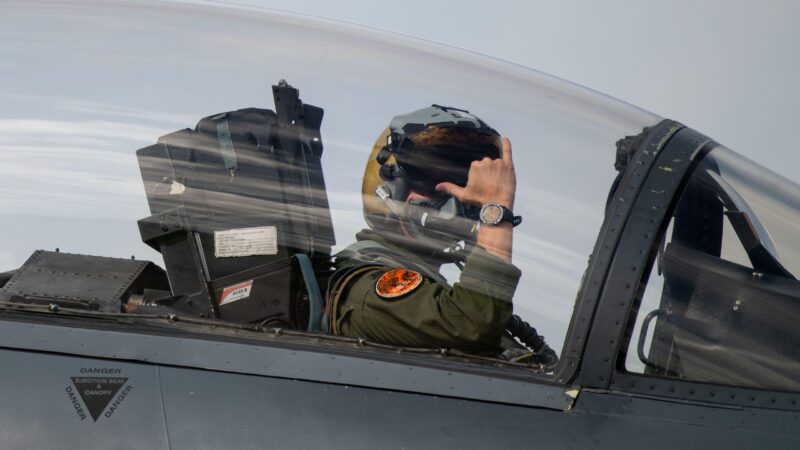
 NAVAL AIR SYSTEMS COMMAND, PATUXENT RIVER, MD.: The NAVAIR Additive Manufacturing team supports Navy and Marine Corps maintainers with AM training, engineering support and technical data to increase readiness in forward-deployed locations where traditional logistics are contested.
Recently, Marine Aircraft Logistics Squadron 36 (MALS-36) and 18th Maintenance Group (18 MXG) maintainers used AM to return a U.S. Air Force F-15 Eagle to the fight in hours, several months ahead of its projected return to service date.
Additive manufacturing, the ability to “print” replacement parts by building materials layer by layer at the time and point of need, is strengthening its role as a force multiplier in the Air Force, according to Depot Liaison Engineer U.S. Air Force Capt. Diego Carrillo. “In applications where 3D manufactured parts are a viable option and are non-procurable or have a long lead time, using this capability can offer cost and time savings. This capability is critical when items are not available from the supply chain or cannot be purchased from industry when needed,” he said.
This was the case with an F-15’s right-hand cockpit cooling duct. When Air Force maintainers at Kadena Air Base, Okinawa, Japan, discovered the crack during inspection after a flight, they estimated that the aircraft would be grounded for three to four months. At first, they sought to repair it using traditional repair processes with the intent of using as much of the original material as possible. After consulting with a depot liaison engineer, however, they turned to additive manufacturing to print and replace the item.
Initially, 18 MXG maintainers printed out two prototypes but experienced technical difficulties before they could print a part that met specifications. Knowing MALS-36 had the same machine, they reached out to them for assistance. Two prototypes were printed, delivered and fit checked in less than 12 hours.
The collaboration yielded another unexpected benefit: after analyzing the Air Force’s technical data package, the Marines came up with an improved design that reduced the part’s print time by two hours.
“We were skeptical of the first design provided by [the MALS] due to the significant shorter print time compared to our first prints. Our techs learned that the duct’s orientation affects the necessity for the support structures, which allowed the Marines to reduce the duct’s print time without compromising its structural integrity,” he said.
“Here was a situation where a multi-million dollar aircraft was going to be sidelined for months due to the lack of a part in the supply system,” NAVAIR Additive Manufacturing Program Manager Theodore Gronda said. “The Air Force’s proactive, forward-leaning maintainers sought and obtained approval to repair the part using their on-site AM capability. 18 MXG was backstopped by MALS-36’s AM capability and they even got a better and quicker AM design out of the collaboration. This was truly a glowing example of a ‘One Team, One Fight’ effort.”
Carrillo sees the outcomes of this effort going beyond a single aircraft and the Air Force. “The duct’s new printing requirements are now part of the Air Force’s AM technical publications and will be used for similar repairs across the F-15 community,” he said. “Cooperative and joint exercises with sister services and other stakeholders can help cross-pollinate ideas and methodologies, strengthen partnerships and increase force effectiveness.”