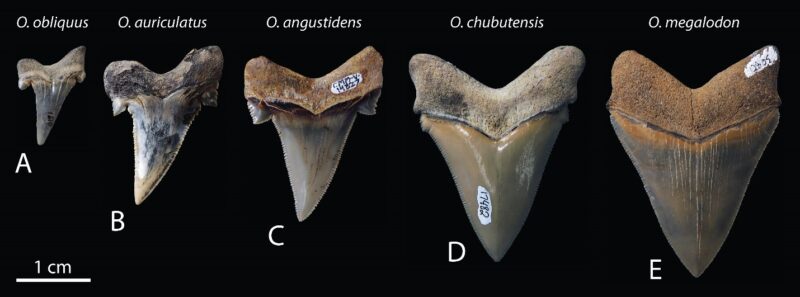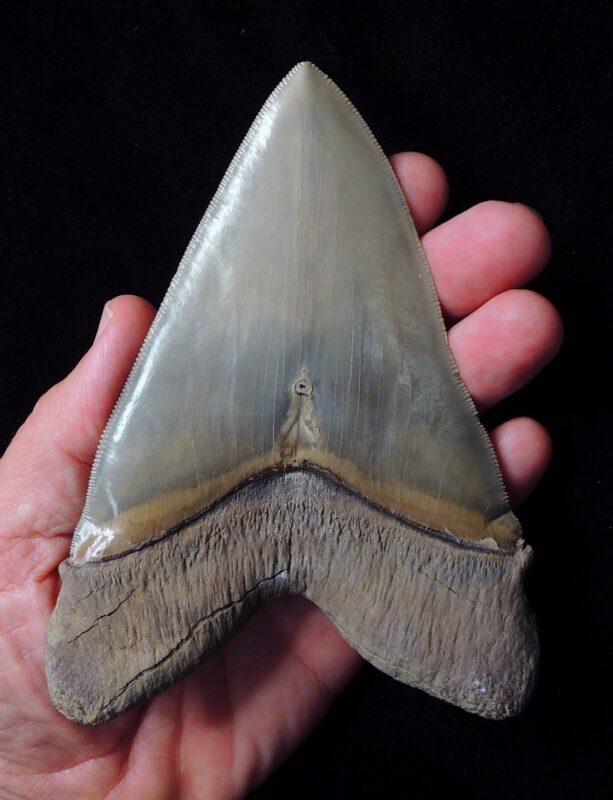
 Strong teeth are essential for many animals, especially those that eat hard foods such as bone or shell. To understand how tooth strength evolved in giant sharks, we studied fossil teeth from the extinct megatooth shark Otodus megalodon and its ancestor, O. obliquus. We focused on the outer enameloid layer of the teeth, which is the shark equivalent of enamel, to see whether it was reinforced in areas that experience the most stress during feeding.
Zinc is known to strengthen hard structures like teeth and claws in many animals. Using micro–X-ray fluorescence (µ-XRF), we mapped zinc levels across the tooth crowns of both shark species. In a paper recently published in Palaeontologia Electronica, we found that O. megalodon teeth had the highest zinc concentrations along the cutting edges and tip, and the lowest levels near the root of the tooth. These high-zinc areas match the parts of the tooth that experience the greatest stress during feeding simulations.
In contrast, O. obliquus teeth did not show clear zinc reinforcement along the edges, although zinc levels were also lower near the base of the tooth. Fossil bite marks suggest that O. megalodon mainly fed on marine mammals such as whales and dolphins, while O. obliquus likely fed on fish. These findings support the idea that as these sharks evolved to hunt larger, tougher prey, natural selection favored teeth reinforced with zinc to withstand stronger biting forces.
This paper was a collaboration between researchers from St. Mary’s College of Maryland, USA, and the Calvert Marine Museum, Maryland, USA.
Publication: On the Cutting Edge: Otodus megalodon Strengthened Tooth Edges Through Zinc Incorporation in Enameloid. Published in Palaeontologia Electronica. https://palaeo-electronica.org/content/
Luke Schwenk ([email protected])
Dr. Geoffrey Bowers ([email protected])
Dr. Victor Perez ([email protected])
Dr. Stephen J. Godfrey ([email protected])