 A yearly study that monitors oyster reproduction in the St. Mary’s River measured a record number of juvenile oysters in 2025. Strong reproduction is a positive sign for the river’s oysters, which filter the water, provide habitat, and support a significant local fishery.
The St. Mary’s River Watershed Association (SMRWA) has tracked oyster reproduction in the St. Mary’s River after a pilot study began in 2018. Each year, they deploy four wire mesh traps filled with oyster shells at 12 sites throughout the river in May and collect them in late October.
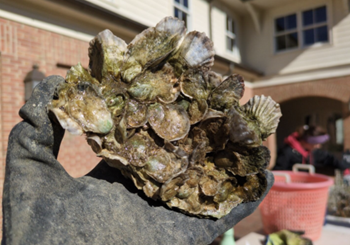
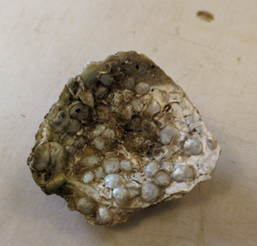
The wire traps that SMRWA deploys mimic an oyster reef at the bottom of the river. Oysters begin their life as free-swimming larvae looking for a place to attach, preferably an oyster shell. Once they attach, they are called “spat,” and spend the rest of their lives in that same location.
In this study, SMRWA measures oyster reproduction by counting the number of spat that have recently settled onto the shells inside of the traps. While they traditionally count the spat contained in each trap, this year, they were only able to count half, and it took them three times as long. They enlisted 29 community volunteers, including local residents and high school students from the Forrest Career and Technology Center in Leonardtown, to help identify and count the spat.
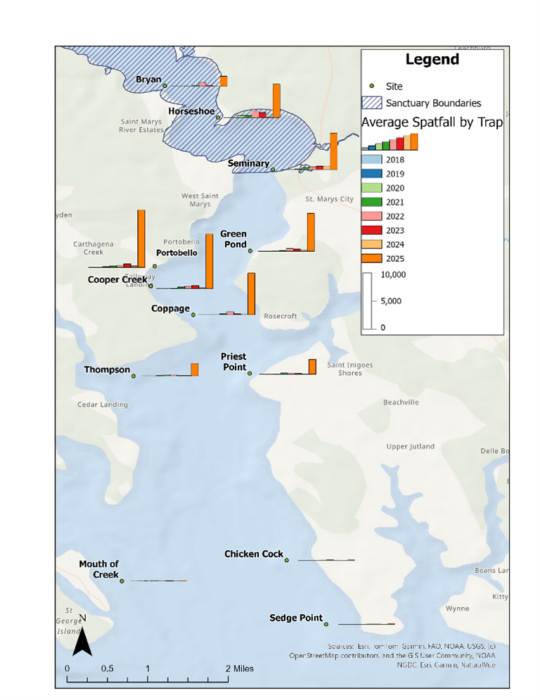
Spatfall smashed records in 2025, averaging 4,427 spat per cage—over eleven times higher than the previous record of 398 spat per cage in 2022.
The study was funded by the Maryland Department of Natural Resources.
“These spat results are great news for the oysters in the St. Mary’s River,” said Gina Hunt, associate director of DNR’s Fishing and Boating Services. “Throughout the Chesapeake Bay, we’ve seen overall oyster population increases, several years of good spatsets, low mortality, and successful reproduction at Maryland’s large-scale restoration sanctuaries, including the St. Mary’s Sanctuary.”
The exceptional reproduction could be due to warm temperatures in June and July along with a wet May. “Oysters are triggered to spawn by warming temperatures,” said SMRWA Executive Director Emma Green Ewing. “The weather conditions may have been just right for a massive spawn”
High reproduction could also reflect years of state and local effort focused on restoring oyster populations in the St. Mary’s River. Maryland completed large-scale restoration in the Upper St. Mary’s River Shellfish Sanctuary in 2022, and SMRWA has continued to plant oysters and install reef balls at several sites in the sanctuary. The sanctuary has been largely successful and currently supports a robust and healthy oyster population, which, although off-limits for harvest, can hopefully bolster the downstream public fishery.
For the first time in the course of the study, the site with the most spat was located in the public fishery, hopefully demonstrating the increased health of the entire river and the spill-over of oyster larvae from the sanctuary.
This year’s high spatfall will positively impact the river’s oyster population. According to Green Ewing, “As oysters get older, their reproduction rate increases. We’re hopeful that the oysters that spawned this summer will produce more larvae and drive a rapid increase in the St. Marys’ River oyster population.”
To learn more about SMRWA and support their work, please visit www.smrwa.org
- spat – Oysters younger than one year old.
- spatfall, spatset, set – The process by which swimming oyster larvae attach to a hard substrate such as oyster shell. During this process the larvae undergo metamorphosis, adopting the adult form and habit.
- spatfall intensity – The number of spat per bushel of cultch. This is a relative measure of density used to calculate the spat index.
- spatfall intensity index – The arithmetic mean of spatfall intensities from 53 fixed reference sites or Key Bars: sum of Key Bar spatfall intensities ÷ number of Key Bars