
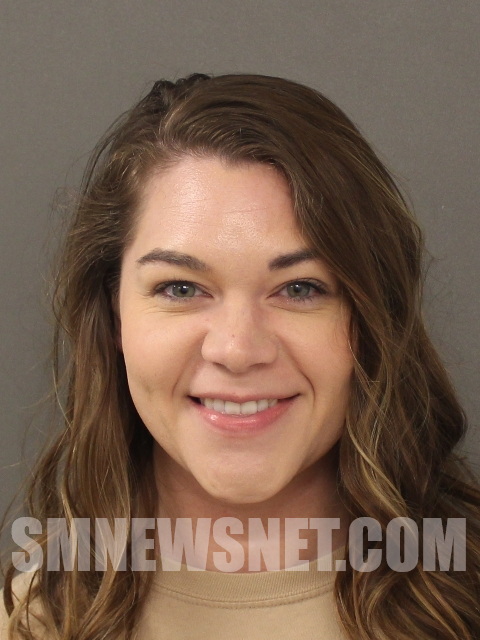
Paige Johnna Eldred, 31, of Chesapeake Beach (2025 Arrest Photo)
Paige Johnna Eldred, 31, of Chesapeake Beach, has been charged in Calvert County District Court with one count of embezzlement or fraudulent misappropriation, 10 counts of stealing another person’s credit card, and three counts of using another person’s credit card for charges under $100, according to court documents. The case was filed on May 23, 2026, and remains open.
The charges stem from an investigation at the Calvert County Detention Center involving inmate commissary funds and the Prestige Prepaid Mastercard inmate release card system. The charging document states the alleged activity occurred between June 2024 and November 2024 at the detention center on Stafford Road in Prince Frederick.
The new case follows a prior theft conviction involving Eldred. In that earlier case, Eldred, then listed as 29 and of Lusby, pleaded guilty on February 24, 2025, to theft of $100 to under $1,500 after funds went missing from the Calvert County Detention Center’s “No Shave November” charity program. She was sentenced to 180 days in jail, with all but 20 days suspended, and placed on 18 months of unsupervised probation.
According to information from the prior case, detention center staff members paid $50 each to participate in the charity initiative, and $950 had been collected and stored in a restricted-access office drawer. On November 27, 2024, a detention center supervisor noticed $500 was missing. The supervisor initially did not report the missing money, hoping it would be returned, but by December 2, 2024, the remaining funds had also disappeared.
Detective Mudd of the Calvert County Sheriff’s Office was notified on December 3, 2024, and opened an investigation. Surveillance footage, staff interviews, and forensic review led investigators to identify Eldred, who was working as a secretary in the administrative office, as the primary suspect. During questioning, Eldred initially denied involvement but later admitted taking the money. She stated that she used the funds to pay rent and planned to return the money. She could not specify the total amount taken but acknowledged placing some money back in the supervisor’s drawer after realizing an investigation was underway. Investigators determined $420 remained unaccounted for.
The current case began after a former inmate returned to the Calvert County Detention Center and requested money that had remained in his inmate commissary account. According to the application for charges, a review of detention center financial records showed the money had already been processed and disbursed through the Prestige Prepaid Mastercard inmate release card system. The former inmate “emphatically stated that he had never received any funds or release card,” according to the charging document.
That report led to what investigators described as a comprehensive audit of the Prestige Prepaid Mastercard program and the detention center’s inmate fund records. Court documents state the audit found multiple suspicious prepaid debit cards created in the names of current and former inmates. Investigators reviewed inmate release dates, booking records, card creation dates, funding activity, account inquiries, transaction histories, and supporting documentation.
According to court documents, investigators found several instances where prepaid cards were created, activated, funded, monitored, and used months or years after the people connected to the cards had already been released from custody. The charging document states that the suspicious administrative transactions and card activity were conducted using administrator-level credentials assigned to Eldred. Investigators wrote that Eldred had full administrative access to the financial systems used to handle inmate funds and release cards, and that she maintained physical control over the card production equipment kept in her office.
The documents also explain how the inmate fund process was supposed to work. Money deposited into an inmate’s commissary account, either during booking or later by family or friends, is held as a digital balance within the detention center’s accounting system and maintained through an account managed by the Calvert County Treasurer. When an inmate is released or transferred, any remaining balance must be returned. For releases, a detention center sergeant issues a physical check for the remaining balance, that check is voided, and the same amount is transferred to a new Prestige Prepaid Mastercard given to the inmate. For transfers to another facility, a physical check is sent with the inmate to the receiving institution.
In both situations, detention center procedure requires the inmate and the shift sergeant to sign a receipt documenting the release or transfer of the funds. A copy of that receipt is supposed to be placed in the inmate’s detention center file. Investigators reported that no signed receipts were found in the files of the people involved in this case.
Court documents state that although the money was associated with individual inmate commissary accounts, Calvert County suffered the financial loss because the funds were maintained through county accounts and the detention center remained responsible for any legitimate funds owed to the affected inmates. Investigators wrote that when unauthorized Prestige Prepaid Mastercards were created and funded through the inmate fund system, the money loaded onto those cards came from county-maintained funds.
The audit identified 10 former inmates whose names were allegedly used to create suspicious prepaid debit cards. Their names are being withheld because they are listed as people whose money, cards, or identifying information were allegedly used without authorization. Court documents state that one card had activity about 10 months after the person was released, another had activity nearly two years after release, and another had activity more than three years after release. In another instance, a card was allegedly created in a person’s name before that person’s actual release date while the person was still incarcerated.
Investigators also reported that the card activity showed immediate activation and funding sequences, often occurring within one or two seconds of each other. The charging document states that investigators viewed that pattern as consistent with administrative system use rather than standard inmate release processing. The audit also found clusters of rapid balance inquiries across multiple unrelated cards on July 5, July 8, July 25, and September 6, 2024.
On July 5, 2024, at approximately 4:36 p.m., cards connected to two different former inmates were allegedly used at exactly the same second at Weis Markets in Lusby. Investigators wrote that this simultaneous use “strongly suggests single individual was in control of multiple cards,” according to the charging document.
The spending activity was concentrated at local businesses in Prince Frederick, Lusby, California, and nearby areas, including Weis Markets, Ulta, Starbucks, Panera Bread, McDonald’s, and other merchants. Investigators wrote that the local spending pattern was inconsistent with use by former inmates who had no knowledge of the cards.
One former inmate was interviewed during the investigation. According to court documents, he stated that he “never received any debit card or money from the detention center after his release.” He also confirmed that he “did not conduct any transactions on card associated with his name.” Investigators wrote that records showed the card tied to his name was activated and funded nearly two years after his release.
Court documents list several alleged release-date discrepancies. One former inmate was released on August 30, 2023, but card activity was recorded on June 26, 2024. Another was released on August 26, 2022, but card activity was recorded on July 5, 2024. Another was released on June 17, 2021, but card activity was recorded more than three years later on July 5, 2024. Investigators also noted similar discrepancies for other former inmates.
The charging document estimates the total identified financial loss to Calvert County at approximately $750 to $800. That figure includes funds loaded onto unauthorized cards, successful purchases, service fees, and non-sufficient funds charges. Individual card losses listed in the document included amounts of about $97.60, $76.83, $196.15, $52.45, $50, $40.50, $37.65, $36.07, $17, and a combined loss of about $121.20 connected to two cards.
In the application for charges, investigators wrote that they believed there was probable cause to charge Eldred with theft and theft scheme, embezzlement or fraudulent misappropriation by a fiduciary, credit card theft, fraudulent use of a credit card, and identity fraud. The formal charges filed in District Court, however, list 14 misdemeanor counts: one count of embezzlement or fraudulent misappropriation, 10 counts of stealing another person’s credit card, and three counts of using another person’s credit card for charges under $100.
The embezzlement or fraudulent misappropriation charge alleges Eldred, acting in a position of trust, fraudulently and willfully appropriated money held in that capacity between June 26, 2024, and July 5, 2024. The 10 credit card theft charges allege she took credit cards belonging to other people without their consent on dates ranging from June 1, 2024, through November 30, 2024. The three fraudulent use charges allege she used cards issued to other people to obtain goods valued at less than $100, knowing the cards had been stolen.
A criminal summons was issued on May 23, 2026. The summons advised Eldred to appear for the July 6, 2026, preliminary inquiry and stated that failure to appear could result in a warrant for her arrest.