
 On Wednesday, July 22, 2026, health officials were made aware of a possible Measles case along with a possible outbreak at MedStar St. Mary’s Hospital.
MedStar St. Mary’s Hospital released a notification to EMS and county officials in St. Mary’s County that effective immediately, all personnel, patients and staff entering the facilities must wear proper face/surgical masks and PPE due to outbreak risk.
Local EMS stations are taking preventive measures with ensuring all of our citizens and patients will be treated with extra care and actions to prevent cases.
No confirmation has been made by health or county officials, however, the CDC and Maryland Department of Health was made aware.
Currently, Measle cases are on the rise with the CDC reporting as of July 16, 2026, there are 2,260 confirmed* measles cases reported in the United States in 2026.
Among these, Maryland recently announced five confirmed cases. Virginia is reporting 129 cases with an outbreak in Buckingham County and Cumberland County.
The Pennsylvania Department of Health launched a new health portal to track measles cases due to the ongoing outbreak their state is experiencing. From April 1st to July 22nd, 2026, they currently have 102 cases with 10 reported within the past 10 days. 61 cases come from Lancaster County, with 20 from Lebanon County.
The Delaware Division of Public Health is reporting its first confirmed measles case in more than a decade. A sample was tested and confirmed positive today. The individual who tested positive is an unvaccinated adult male in Kent County. DPH is unable to provide more details about the individual who tested positive at this time due to medical privacy restrictions.
CDC reports 34 new outbreaks** reported in 2026, and 93% of confirmed cases (2,108 of 2,260) are outbreak-associated (741 from outbreaks starting in 2026 and 1,367 from outbreaks that started in 2025).
The World Health Organization Key facts
- Measles is a highly contagious, serious airborne disease caused by a virus that can lead to severe complications and death.
- Measles vaccination averted nearly 59 million deaths between 2000 and 2024.
- Even though a safe and cost-effective vaccine is available, in 2024, there were an estimated 95 000 measles deaths globally, mostly among unvaccinated or under vaccinated children under the age of 5 years.
- The proportion of children receiving a first dose of measles vaccine was 84% in 2025, slightly below the 2019 level of 86%.
Overview
Measles is a highly contagious disease caused by a virus. It spreads easily when an infected person breathes, coughs or sneezes. It can cause severe disease, complications, and even death.
Measles can affect anyone but is most common in children.
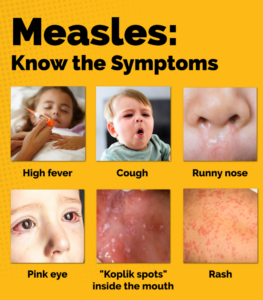
Measles infects the respiratory tract and then spreads throughout the body. Symptoms include a high fever, cough, runny nose and a rash all over the body.
Being vaccinated is the best way to prevent getting sick with measles or spreading it to other people. The vaccine is safe and helps your body fight off the virus.
Before the introduction of measles vaccine in 1963 and widespread vaccination, major epidemics occurred approximately every two to three years and caused an estimated 2.6 million deaths each year.
An estimated 95 000 people died from measles in 2024 – mostly children under the age of five years, despite the availability of a safe and cost-effective vaccine.
Accelerated immunization activities by countries, WHO, the Measles & Rubella Partnership, and other international partners successfully prevented an estimated 59 million deaths between 2000 and 2024. Vaccination decreased an estimated measles deaths from 780 000 in 2000 to 95 000 in 2024 (1).
Signs and symptoms
Symptoms of measles usually begin 7–14 days after exposure to the virus. A prominent rash is the most visible symptom.
Early symptoms usually last 4–7 days. They include:
- fever
- running nose
- cough
- red and watery eyes
- small white spots inside the cheeks.
The rash appears 3 to 5 days after the first symptoms, usually on the face and upper neck. It spreads over about 3 days, eventually downward to the trunk, arms, legs and feet. It usually lasts 4–8 days before fading.
Most deaths from measles are from complications related to the disease.
Complications can include:
- blindness
- encephalitis (an infection causing brain swelling and potentially brain damage)
- severe diarrhea and related dehydration
- ear infections
- severe breathing problems including pneumonia.
If a woman catches measles during pregnancy, this can be dangerous for the mother and can result in miscarriage or her baby being born prematurely with a low birth weight.
Complications are most common in children under 5 years and adults over age 30. They are more likely in children who are malnourished, especially those without enough vitamin A or with a weak immune system from HIV or other diseases. Measles itself also weakens the immune system and can make the body “forget” how to protect itself against infections, leaving children extremely vulnerable.
Who is at risk?
Any non-immune person (not vaccinated or vaccinated but did not develop immunity) can become infected. Unvaccinated young children and pregnant persons are at highest risk of severe measles complications.
Measles is still common, particularly in parts of Africa, the Middle East and Asia. The overwhelming majority of measles deaths occur in countries with low per capita incomes or weak health infrastructures that struggle to reach all children with immunization.
Damaged health infrastructure and health services in countries experiencing or recovering from a natural disaster or conflict interrupt routine immunization and overcrowding in residential camps increases the risk of infection. Children with malnutrition or other causes of a weak immune system are at highest risk of death from measles.
Transmission
Measles is one of the world’s most contagious diseases, spread by contact with infected nasal or throat secretions (coughing or sneezing) or breathing the air that was breathed by someone with measles. The virus remains active and contagious in the air or on infected surfaces for up to two hours. For this reason, it is very infectious. One person infected by measles can generate up to 18 secondary infections.
It can be transmitted by an infected person from four days prior to the onset of the rash to four days after the rash erupts.
Measles outbreaks can result in severe complications and deaths, especially among young, malnourished children. In countries close to measles elimination, cases imported from other countries remain an important source of infection.
Treatment
There is no specific treatment for measles. Caregiving should focus on relieving symptoms, making the person comfortable and preventing complications.
Drinking enough water and treatments for dehydration can replace fluids lost to diarrhea or vomiting. Eating a healthy diet is also important.
Doctors may use antibiotics to treat pneumonia and ear and eye infections.
Two doses of vitamin A are recommended for all suspected measles cases in children under 5 years of age, immediately on diagnosis and repeated the next day, according to the dosing indicated by the health practitioner. A third dose is recommended for any clinical signs of vitamin A deficiency with eye complications and should be given 4–6 weeks later. This restores low levels of vitamin A that occur even in well-nourished children. It can help prevent other complications from measles, including eye damage and blindness. Vitamin A supplements may also reduce the number of measles deaths.
Prevention
Community-wide vaccination is the most effective way to prevent measles. All children should be vaccinated against measles. The vaccine is safe, effective and inexpensive.
Children should receive two doses of the vaccine to ensure they are immune. The first dose is usually given at 9 months of age in countries where measles is common and 12–15 months in other countries. A second dose should be given later in childhood, usually at 15–18 months.
The measles vaccine is given alone or often combined with vaccines for mumps, rubella and/or varicella.
Routine measles vaccination, combined with mass immunization campaigns in countries with high case rates are crucial for reducing global measles deaths. The measles vaccine has been in use for about 60 years and costs less than US$ 1 per child. The measles vaccine is also used in emergencies to stop outbreaks from spreading. The risk of measles outbreaks is particularly high amongst refugees, who should be vaccinated as soon as possible.
Combining vaccines slightly increases the cost but allows for shared delivery and administration costs and importantly, adds the benefit of protection against rubella, the most common vaccine preventable infection that can infect babies in the womb.
In 2025, 77% of children received both doses of the measles vaccine, and about 84% of the world’s children received one dose of measles vaccine by their first birthday. Two doses of the vaccine are recommended to ensure immunity and prevent outbreaks, as not all children develop immunity from the first dose.
Approximately 29 million infants remained under-protected against measles in 2025, according to WHO and UNICEF estimates.